
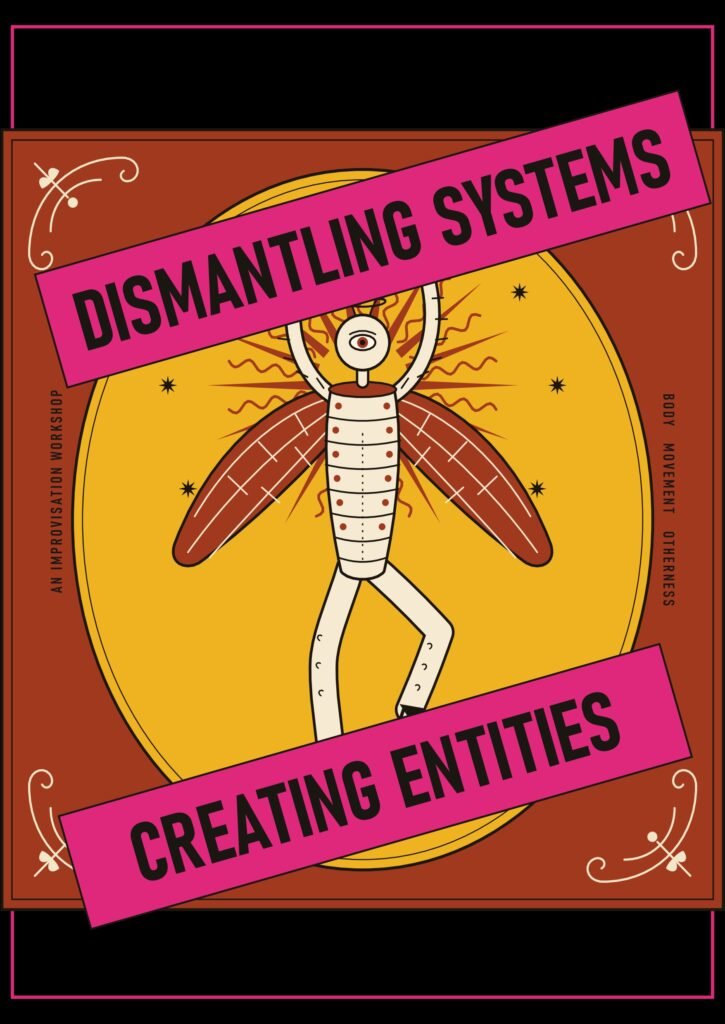
Dismantling Systems,
Creating Entities
Systems injure us: colonial, extractive, patriarchal. We can’t always change them, but in the imaginary space of performance we can confront them, reimagine them and maybe even overcome them.
The workshop starts from the Virginsect, an entity born in a performance praying the rosary of extraction. Through syncretism, the tool that let sacred images mutate and survive, the Virgin becomes a being who knows the land where extraction happens, where fungi and insects heal and regenerate what was wounded.
We begin from where we are. We care for the injuries these systems leave in our bodies and, through improvisation, dance and sound (rhythms travelling across Latin America), each participant builds their own entity: a regenerator able to confront, dismantle or reimagine the systems that shape us.
The body’s capacity to tell its own story. This improvisation workshop explores the body and its movement within its physical and narrative capacities. Guided by various sensitive and structural imaginaries, the workshop seeks to offer a variety of tools with which participants can investigate their moving body in relation to a creative impulse. Communicating in its own language, the body plays with the possibilities offered by space, context, and the bodies that accompany it.
Body Grammar, Playing Through Narratives
Improvisation Workshop by Gabriel Zúñiga
This workshop was held in:
TanzQuartier. Vienna
Beat1060 . Vienna
SEAD . Salzburg
La Casona de la Danza. Bogotá

The workshop offers a variety of creative tasks centered around rhythmic-motor expansion, pattern composition, and the creation of fictions. In this way, a language is generated through which physical capacities are explored—encompassing skeletal structure, muscular-imaginative capacity, and endurance. This language allows the body to investigate its danced gesture, generating new movement pathways, contrasts, asymmetries, and mobilization of the center. The production of imaginaries that enable the body to discover diverse ways of moving connects directly with the work of authors such as Yuderkys Espinosa Miñoso, who ground the construction of memories, counter-memories, and narratives in the production of affects and sensibilities that, in this case, run through the dancing body.
